Shipping fast is easy.
Shipping something people trust - under pressure - isn’t.
I operate where AI velocity meets real production pressure.
I bring structure, guardrails, and production-grade Design - in visuals, interactions, and system behavior.
No noise. No slop. Just shipped software.
i-Rays - Enterprise Observability for IBM i
STATUS: DEPLOYED | SECTOR: Enterprise SaaS / AI Observability | SCOPE: PRODUCT WEBSITE | DURATION: 10 WEEKS
- Context
New-to-market IBM i observability platform. Communication framework defined. No existing marketing materials, no publishable visuals, no website. Fixed US conference deadline.
- My role
Solo Product Designer - product website architecture, visual system, AI imagery generation and QA, cross-media execution.
- CONSTRAINTS
Team distributed across PL + US. 10-week hard deadline tied to US conference. Stock photography didn't fit the visual direction. AI-generated imagery required enterprise-level trust mechanics for a technically skeptical audience.
- WHAT I SHIPPED
7-page responsive product website. Enterprise visual system + brandbook chapter. Modular sales deck. 4x3m conference backdrop. One-pagers EN/ES. Video direction. Blog architecture. 100+ AI imagery iterations with QA protocol.
- IMPACT
Website shipped on time for US conference. AI imagery QA protocol adopted as team standard for future projects. Zero missed deadlines across 12 deliverables.
- AI USAGE
100+ Midjourney iterations across 5 hero directions. Custom QA protocol: credibility benchmark, artifact elimination, brand alignment at every output.
VIEW LIVE DEPLOYMENT
The messaging framework was ready. The visual form wasn't. A new IBM i observability platform needed a website that could convince a CIO, an IT Ops lead, and a 50+ mainframe operator - simultaneously. Ten weeks. Distributed team across two time zones. No existing visuals. One designer. Twelve deliverables.
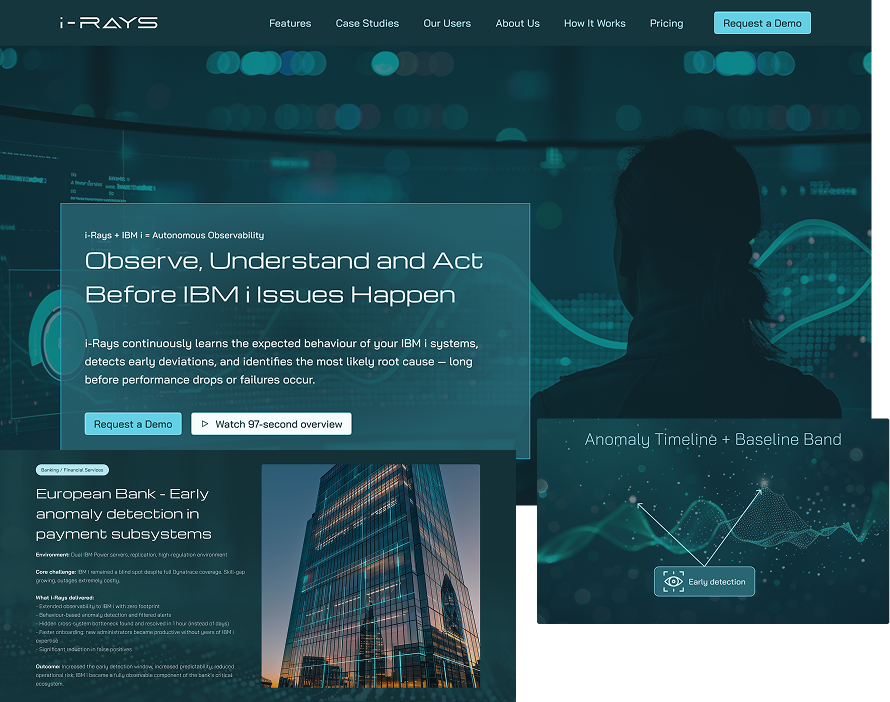
01 / Credible
Behaviour-Driven Observability positioning translated into a 7-page product website. Five hero directions tested across 100+ AI imagery iterations. Enterprise brandbook authored and handed off. Zero AI-glow.
02 / Conflicting creative visions
Multiple creative perspectives across 3 organizations navigated without a single missed deadline. Vinyl print constraints solved. AI-imagery concerns absorbed and redirected into a structured evaluation protocol.
03 / Human
3 personas designed for (CIO, IT Ops, IBM i Admin). Cliche corporate imagery eliminated. Diverse, human-first Hero chosen through structured evaluation. Blog system built as empathy architecture.
- The mission
The product's communication framework was already defined. The challenge: give it a visual form that earns trust from a 50+ IBM i Admin who has seen every enterprise marketing trick in the book.
- Alternatives considered
Pure UI screenshot approach (rejected - no publishable product screens available). Abstract illustration (rejected - too generic for the target audience's credibility threshold).
- Why this
Enterprise trust isn't built with pretty visuals. It's built with evidence - structured information, inspectable data, specific proof points at every section.
- Risk monitored
IBM i Admin persona drop-off rate at hero and features sections.
- The mission
Stock photography didn't fit the visual direction. Timeline didn't allow for a photo shoot. AI generation was the only viable path - but AI couldn't look like AI to a technically skeptical, 50+ audience.
- Alternatives considered
Traditional photography (rejected - timeline constraint). Stock imagery (rejected - visual direction mismatch). Dashboard-only, no-people visual (considered as safe fallback).
- Why this
5 distinct hero directions defined and tested. 100+ Midjourney iterations across the project. Structured team evaluation. One direction approved. QA protocol - credibility review + artifact elimination - established and handed off as team standard.
- Risk monitored
Perceived authenticity of imagery with IBM i Admin persona.
- The mission
Web, PowerPoint deck, 4×3m vinyl, video direction, and one-pagers EN/ES - each with fundamentally different technical constraints. One coherent visual system had to clear all of them.
- Alternatives considered
Per-medium visual adaptation (rejected - coherence loss at sales stage). Web-first only (rejected - conference deliverables were non-negotiable).
- Why this
A product website without aligned collateral loses credibility exactly when it matters most - at the sales conversation. Every medium treated as part of one system.
- Risk monitored
Visual coherence across media. Rendering fidelity in print (CMYK) and presentation (system fonts) environments.
12 DELIVERABLES // 7 WEBSITE PAGES // BRANDBOOK CHAPTER // SALES DECK // 4x3m VINYL BACKDROP // VIDEO DIRECTION // ONE-PAGERS EN/ES // 100+ AI IMAGERY ITERATIONS // MOBILE RESPONSIVE
/ AUTH: M. ALEKSANDER [ VERIFIED ]

Governing Design at Scale
STATUS: FRAMEWORK VALIDATED | SECTOR: ENTERPRISE B2B / INTERNAL TOOLING | SCOPE: DESIGN SYSTEM GOVERNANCE | DURATION: 12 MONTHS
- Context
Multi-product ecosystem built on a shared core DS. Products ranged from precision configuration panels to high-speed operational dashboards - fundamentally different cognitive contracts, identical components.
- My role
Design Systems Lead - audit, token architecture, federation model, Product DNA Profiles, governance operating system, AI-augmented documentation, DS Sentinel QA agent.
- CONSTRAINTS
No central enforcement authority. Products with conflicting UX demands. Multiple teams, multiple priorities. Governance had to accelerate delivery - not introduce a new bottleneck. No exceptions.
- WHAT I DESIGNED
Token taxonomy. Federated architecture model. Product DNA Profiles. Contribution workflow. Decision log. AI documentation pipeline. DS Sentinel QA agent. Migration playbook. QA checklist.
- IMPACT
Framework validated by the team as strategic direction. Documentation pipeline proven: 150+ components in 1.5 days vs. weeks. DS Sentinel approved as a Q2 automation initiative. AI cut documentation manual work by 80%+.
- AI USAGE
Component description generation from structured templates. Icon tagging pipeline for 150+ icons (Font Awesome names, tags, metadata). Documentation scaffolding. DS Sentinel with strict no-hallucination guardrails.
[ DESIGN SYSTEMS ] [ FEDERATION MODEL ] [ AI-AUGMENTED OPS ] [ AI AGENTS ]
Inherited a core design system with no documentation standards, no contribution model, and no governance. Multiple products relied on it - but with cognitive demands so different that forcing identical component behavior was producing friction, not consistency.
Designed a federated governance model: shared visual DNA at the core, product-specific behavioral contracts at the surface. Rebuilt documentation with AI-augmented pipelines. DS Sentinel proposed as the automated compliance layer.
Role: Design Ops / System Lead (B2B, Contract)
Duration: 12 months
01 / Federated Architecture
The breaking point was a status indicator. In a configuration panel – calm, understated, acceptable. In an operational dashboard – invisible, low urgency, failing to trigger response. Same component. Same design system. Two completely different cognitive contracts.
I realized enforcing 1:1 parity across products with fundamentally different purposes wasn’t consistency – it was a structural error. I designed a Federated Design System: the core DS defines the visual contract. Product DNA Profiles define each product’s behavioral constraints – urgency thresholds, error consequence weight, time-to-task targets. Where the core DS ends, the DNA Profile governs. Where the DNA Profile doesn’t cover an edge case, the Decision Log takes over.
Three layers. No gaps. Framework validated with the team – approved as a next Q initiative.
02 / AI-Augmented Velocity
Documentation was either missing or dead on arrival. I rebuilt it across Figma and Confluence using structured templates – repeatable, predictable, cross-linked for
designers, PMs, and developers.
Then integrated AI to scale what would otherwise take weeks. Micro-case: 150+ icon components, each requiring name, Font Awesome reference, tags, and
usage metadata. Manual: days of one-by-one entry. AI-augmented: a custom super-prompt embedded directly in the workflow, generating structured outputs
in 1.5 days.
Same approach for component descriptions – voice transcription turned into structured Figma documentation via a generation pipeline. Every output reviewed and edited against system logic. No raw AI outputs shipped.
03 / Automated Governance (DS Sentinel)
To prevent decision drift across a federated system with multiple contributing
teams, I designed DS Sentinel – an AI QA agent loaded with the complete design
system: token rules, component specs, Product DNA Profiles, edge case decisions. Core design principle: if uncertain, flag for human verification. Never generate hypotheses. Never fill gaps with assumptions.
Concept: paste a UI screenshot and Figma-exported CSS, receive an instant
compliance audit – wrong token, missing semantic assignment, questionable component in context. DS Sentinel wouldn’t replace design review. It would become the first firewall, so human review could focus on judgment rather than pattern-matching.
Proposed extension: MCP server integration for live Confluence access – enabling continuous automated compliance without manual refresh cycles.

- The mission
Core DS defines the visual contract. Product DNA Profiles govern surface behavior - within guardrails.
- Alternatives considered
Single central DS team owning all decisions (rejected - bottleneck, kills velocity).
- Why this
Autonomy within constraints is faster and more resilient than controlled dependency.
- Risk monitored
Drift rate across products - success metric.
- The mission
Stability, versioning, and deprecation treated like engineering interfaces - not design assets.
- Alternatives considered
Flat Figma styles (rejected - no semantic layer, no migration path).
- Why this
Without versioning, every DS update is a breaking change.
- Risk monitored
Token adoption rate across codebases.
- The mission
Where possible, automated checks. Where not: lightweight decision reviews, not committees.
- Alternatives considered
Full manual review process (rejected - doesn't scale). No process at all (rejected - chaos).
- Why this
DS Sentinel handles pattern compliance. Humans handle judgment calls.
- Risk monitored
Time-to-merge for contributions.
AI changed the velocity.
The vector remained the same.
The market treats AI as a magic wand that replaces the design process. It isn't. AI is an accelerator, but acceleration without a steering wheel is just a crash waiting to happen.
Before AI made design output cheap, I spent 15+ years engineering trust in complex, high-stakes environments. I was never in the business of decorating UI. I was in the business of operational efficiency, risk mitigation, and decision governance.
Algorithms can generate options, but they cannot take responsibility. The muscle memory required to ship robust software - system mapping, defining constraints, hunting edge cases, and pushing through engineering bottlenecks - was trained long before LLMs existed.
What you see below is the raw data from previous missions. The tools were different. The standard was the same.
Complex Systems & Integration
Before AI agents, there was logic, latency, and backend constraints.
- The mission
BuildBook / Chat Integration
- The Reality
Designing a chat experience isn't about drawing speech bubbles. It's about data architecture, session logic, and backend permissions. When integrating a third-party chat (Sendbird) into a proprietary construction management tool, or mapping UX for legacy mainframe environments, user research was often scarce, but technical constraints were brutal.
- The Legacy DNA
Working backwards from the API. When research is limited, governance and rapid feasibility prototyping become the substitute for certainty. UX becomes a function of permissions and recovery paths, not just layout.
"I worked closely with Michał for a year and a half and I’ll remember this time as the best designer-engineer cooperation I have experienced. Michał has enormous expertise in both UI and UX fields. He combines creativity with a solid data-driven mindset, and he constantly does his best to reconcile both product and engineering perspectives. He understands the challenges of modern product development and guarantees success all the way from defining business goals to implementation."
External Quality Gates
Before algorithmic validation, there was Apple.
- The mission
OLX / Apple Step Up Program
- The Reality
Collaborating directly with Apple engineers to align a massive marketplace app with strict iOS HIG standards under a tight deadline.
- The Legacy DNA
When the quality standard is external and unforgiving, you don't win with "pretty screens." You win with clear rationale, rapid clickable prototypes, and an airtight collaboration with dedicated developers. You ship reality, not demos.
"Working with Michał was a pleasant journey on making a great product. He showed his design expertise in multiple occasions, bringing his creativity to light. Putting the customer first, and making data-driven decisions. He always goes an extra mile in achieving great user experience."
BuildBook - Mobile UX for the Jobsite
Before AI research synthesis, there was a broken webview and 400 field workers telling you exactly why it failed.
- The mission
BuildBook / Mobile App Redesign
- The Reality
A webview adapted for mobile - failing construction workers with limited internet on real job sites. Rebuilt from field research: interaction flows, personas, journey mapping, 400+ surveys. One task-focused dashboard that worked.
- The Legacy DNA
Mobile UX isn't what looks good in a demo. It's what works when the signal drops. Data is the only permission to simplify - without it, you're deleting features that field workers depend on.
"Michał is one of those designers that goes above and beyond - always seeking ways to improve himself, and those around him. His superpower is that he combines a strong design and research skillset together, which enables him to deeply understand the problem to be solved and generate multiple solutions on how to solve it. He also has a deep curiosity and innovated in the area of bringing AI into his design workflow, and sharing his learnings with the entire team. Michał is a fantastic designer to work with, and I highly recommend him!"
Algorithmic Trust at Enterprise Scale
Before generative AI, there was predictive ML under massive load.
- The mission
HolidayCheck AG / Enterprise Travel Platform
- The Reality
Redesigning booking flows and core management tools for an ecosystem with 40M+ users. Integrating early ML-powered insights into high-traffic journeys meant dealing with real business constraints where millions of euros were on the line. The challenge wasn't just implementing the algorithm - it was translating algorithmic output into human decision clarity.
- The Legacy DNA
Scaling UX across millions of users teaches you that algorithms are useless without operational confidence. To make machine learning actionable, you have to design transparent feedback loops and align massive cross-functional teams (Product, Engineering, Data). This was the original testing ground for designing human-AI symbiosis: ensuring users actually trust the machine's recommendations when it matters most.
"Michał is easily one of the best, most well-rounded UX professionals I've worked with. He has the experience needed to partner with product owners and lead teams toward a well-defined vision. He is a natural leader who can roll up his sleeves to get great design into production."Michał is a fantastic designer to work with, and I highly recommend him!"
Legacy Skillset → AI-Augmented Practice
Legacy: Weeks of discovery, data gathering, and alignment workshops to build a plan. AI-Augmented: AI parses transcripts, logs, and raw data in minutes. I provide the judgment: defining leverage, extracting noise, and setting non-negotiable constraints within 48 hours.
The core remains exactly the same: Judgment. System Thinking. Feasibility. But the artifacts have evolved. What used to be scattered across Slack threads and Jira tickets is now a hardened, AI-accelerated Operating System.
01 / Feasibility memo (48h)
- Legacy
Weeks of discovery, data gathering, and alignment workshops to build a plan.
- AI-Augmented
AI parses transcripts, logs, and raw data in minutes. I provide the judgment: defining leverage, extracting noise, and setting non-negotiable constraints within 48 hours.
02 / Decision log
- Legacy
Transparent workflows relying on manual documentation of iteration and feedback.
- AI-Augmented
A centralized system of accountability. AI summarizes the context, but the log enforces governance: who owns the decision, what are the trade-offs, and when does it decay.
03 / Edge-case matrix
- Legacy
Manual heuristic evaluations, usability testing, and session replays (FullStory) to find where users break the system.
- AI-Augmented
AI generates comprehensive failure modes and abuse scenarios upfront. I prioritize them based on business risk and map the recovery paths before a single line of code is written.
04 / Calibration gates
- Legacy
Weekly alignment syncs and design reviews.
- AI-Augmented
Hardened checkpoints. What do we know? What is hallucinated? What are we instrumenting for the launch?
Speed is solved. Anyone can generate a screen in 2026. But shipping an enterprise-grade product that doesn't collapse under pressure? That still requires an operator in the cockpit.